Teletext: a new old-fashioned way to read the news
OnlineBuilt and running now, free for anyone to use.
Key in a three digit page number and wait. If you grew up in Britain before the web, that instruction needs no explanation. Teletext was the information service that lived inside the television: news, sport, weather and the football scores, painted on the screen as chunky coloured blocks of text and cycled through one page at a time. It was slow, it was charming, and for a couple of decades it was how a lot of us checked the world.
My own first sight of it was not on some fancy television set. In the early days you could buy, or build, a little box that bolted teletext onto an ordinary TV, and that is how I first saw the pages cycle in. I was amazed. The idea that all this news and sport was simply arriving alongside the picture, ready the moment I keyed in a number, felt close to magic at the time. Something about it stuck.
Part of what stuck was the brevity. Teletext had no room for a long comment or a hot take. A story was a headline and a handful of lines of plain fact, then the next page came round. I still enjoy that simplicity, and it is half the reason I wanted to rebuild the thing.
It effectively died in 2012. This is a small experiment in pretending it never did.
It lives at teletext.ghz599.net. The look, the page numbers and the constraints are all authentic 1970s and 80s teletext. The twist is the content: the pages are real and current, rewritten three times a day by an AI from live broadcaster feeds. The presentation is pure nostalgia, the words underneath are today’s.
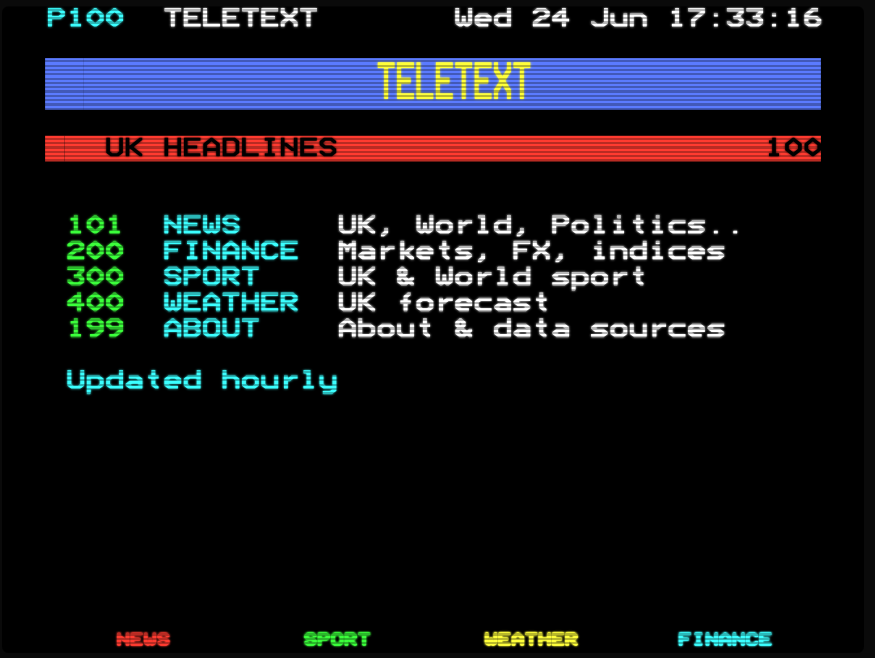
What if it had never gone away
The question I wanted to play with was simple. If teletext had survived into the present, what would it look like fed a modern, live world? Not a static museum piece, but the real service it always was, still ticking over with this morning’s headlines.
So I kept everything that made it teletext and changed nothing about the form. The 40 column by 24 row character grid. The seven colours. The double height headlines. The navigation by page number rather than by link. Then I wired the back of it to live data and let an AI do the writing. It is part nostalgia piece and part technical exercise in working inside genuinely tight constraints, which turns out to be the more interesting half.
I have tried to stay faithful to the old Ceefax and Oracle services, but I should be honest that I have taken a few design liberties along the way. Some of the original behaviour is hard to reproduce exactly, and some of it I simply changed because it suited how I wanted to use this. It is an affectionate recreation rather than a museum grade reconstruction.
What it does
The service pulls live feeds from established UK news organisations, the BBC, Sky News, Channel 4, the Guardian and the Independent, across news, business and sport. It clusters related stories together, then has the AI rewrite each cluster into the terse, headline shaped house style a teletext page needs. The result is laid out as numbered pages and published, and a browser renderer paints it onto the classic grid. The whole thing refreshes on a schedule with no human in the loop, so it is a genuinely autonomous, always current publication rather than something I sit and update.
The sections sit where a teletext viewer would expect to find them, by page number:
| Page | Section | Source |
|---|---|---|
| 101 | News index | BBC, Sky, C4, Guardian, Independent |
| 110 to 150 | News categories and stories, including Tech | AI rewritten |
| 200 | Finance, markets dashboard | Delayed Yahoo quotes, not advice |
| 201 onward | Finance stories | City AM, BBC, Guardian, AI rewritten |
| 300 to 320 | Sport, index, UK and World | BBC, Sky, Guardian, Independent |
| 400 to 408 | Weather, regional forecasts | Open-Meteo, no AI at all |
There is only a modest amount on the feed at the moment, a few stories per section rather than a full newspaper, and that suits how I actually mean to use it. My plan for my own copy is to set it to auto and let the pages roll round on a screen in the corner of the room, so I can keep half an eye on the news the way you once would have with the set on in the kitchen.
The AI writes the words, the code owns the layout
This was the governing rule of the whole build, and the bit I would point anyone at first. The AI never sees a pixel or a grid coordinate. It is handed text and strict length limits and asked for words that fit, and then deterministic code places those words on the grid. The model does the part it is good at, which is turning several news reports into one tight summary in a particular voice, and the code does the part it must never get wrong, which is the exact character counts and colours of a layout that has to be pixel faithful.
It is a small illustration of a thing I keep finding useful: do not ask a language model to do the job that ordinary code does perfectly and predictably. Constrain it to the genuinely hard part and let the deterministic side keep it on the rails.
Keeping the bill down
Because this runs forever on a schedule, cost was a real design constraint rather than an afterthought, and a couple of the more satisfying decisions came out of that.
The cron job runs every 30 minutes, but the expensive part, the AI clustering and rewriting, only actually fires at three fixed bulletin times a day, at six in the morning, one in the afternoon and six in the evening, gated internally against the clock. The free feeds, the markets and the weather, still refresh every half hour. Forty-five runs in every forty-eight short circuit at zero AI cost. So you get fresh markets and weather every half hour, fresh AI news and sport three times a day, and the token bill comes out at a small fraction of running the AI on every tick. The publishing schedule and the spending are deliberately decoupled.
On top of that the synthesis is incremental. Stories already written are cached and reused, so the AI is only paid for genuinely new clusters each run, not for redrawing the whole front page every time. The writing itself goes through the batch API at half price. Nothing here is waiting on an instant answer, so latency is the one thing this project can happily spend instead of money. The model doing the writing is Claude Haiku, the cheapest capable option, which is the right call when something has to run quietly and indefinitely.
Honesty about the limits
It is worth being precise about what the AI does and does not do here. It rewrites and summarises real reporting from real feeds into the house style. It does not invent news from nothing. A story only earns a page when at least two independent outlets are covering it, which is a cheap but effective guard against single source noise. The weather pages and the markets dashboard use no AI at all, they are straight from the data. So the AI is a sub editor working to a tight column width, not a reporter.
I have also been careful about which feeds I draw on. There are other sources I could have used, but where it was not completely clear to me that reuse was allowed, I left them out. I would rather have a thinner feed I am confident about than a fuller one I am not sure of. This is built for my own personal use, it is firmly non-commercial, and it only ever borrows headlines and hands them straight back. Wherever I do use a source I want to be certain it is permitted and, just as importantly, to credit it openly and always.
A note on how it was built
As with everything here, I should be open about how it was made. The idea, the design and the insistence on getting the teletext look exactly right are mine. The code, the PHP generator on the server and the front end renderer, was written with heavy use of AI assistance, and the content is AI written by design. Part of what I enjoy about a project like this is seeing how far one person can take an idea with these tools. The stack is deliberately plain and durable: a static front end for the display, a PHP generator that fetches, clusters, rewrites and lays out the pages, and Hostinger shared hosting with a GitHub Actions deploy and a cron every half hour.
With thanks
None of this would work without the feeds that others make available, and every story is drawn from two or more of them. The news comes from the BBC, Sky News, Channel 4, the Guardian and the Independent. The finance stories come from City AM, the BBC and the Guardian, while the market prices on the dashboard are delayed Yahoo quotes, shown for interest and not as financial advice. The sport comes from the BBC, Sky, the Guardian and the Independent, and the forecasts come from Open-Meteo. All rights in that content stay with the people and organisations who produce it. The service simply borrows the headlines for a few hours and hands them back in a font your television would recognise. That font deserves its own credit: the authentic teletext lettering is Bedstead, a public domain typeface by Ben Harris, and it is what makes the pages look exactly right.
Where it goes from here
This is very much a first drop, and I honestly do not know yet where it will go. I might add sections, or I might leave it exactly as it is and just enjoy having it roll round on a screen. I am not claiming any of this is new. There are other recreations out there, some of them better than mine, and people have certainly done cleverer things with the format. I just liked the idea of a bit of retro tech and wanted to have a go and see what was possible. That is the whole of it.
If you remember waiting for page 302 to come round again, this is for you.